Have you ever paused while writing a sentence and wondered whether the correct spelling is puting or putting? It is an easy mistake to make, especially when you are trying to apply English spelling rules to everyday verbs. Although both versions might look reasonable at first glance, only one is correct in standard English.
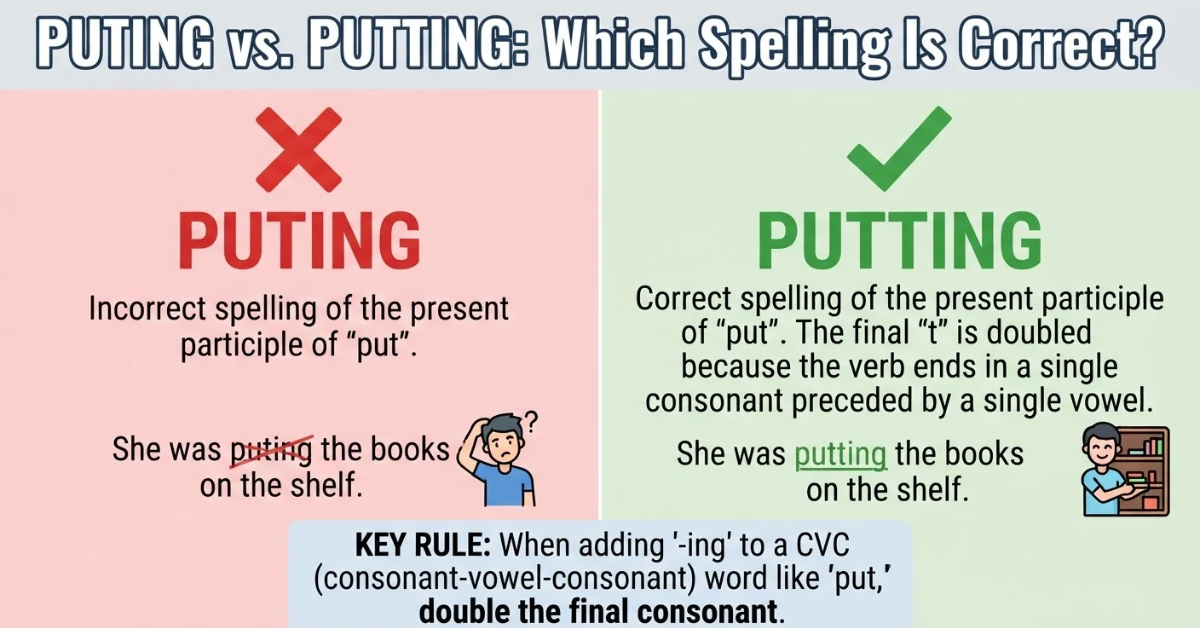
The correct spelling is putting, with two T’s. It is the present participle and gerund form of the verb put. Whether you are describing someone placing an object somewhere, explaining an action, or talking about a golf technique, the spelling remains the same.
In this guide, we will explore the difference between puting and putting, explain the spelling rule behind the extra T, and look at practical examples, synonyms, and common questions to help you use the word confidently.
Puting or Putting: The Correct Spelling Explained
If you are searching for puting or putting, the answer is straightforward: putting is the correct spelling, while puting is incorrect.
The confusion usually happens because English verbs follow different rules when adding endings such as -ing. Some verbs simply lose a letter or keep their original spelling, while others require a doubled final consonant.
The verb put belongs to the second category.
Here is a quick comparison:
| Spelling | Correct or Incorrect? | Explanation |
| Putting | Correct | Standard -ing form of put |
| Puting | Incorrect | Missing one T |
| Put | Correct | Base form of the verb |
| Puts | Correct | Third-person singular form |
| Put on | Correct | Phrasal verb |
For example:
-
Correct: She is putting the books on the shelf.
-
Incorrect: She is puting the books on the shelf.
Remembering the double T makes it easier to avoid this common spelling mistake.
What Does Putting Mean? Definition and Meaning
The word putting comes from the verb put, which generally means to move, place, or position something in a particular location.
It can also describe taking action, applying effort, or directing something toward a particular purpose.
According to its grammatical use, putting can function as either a present participle or a gerund.
1. Putting as a Present Participle
A present participle is formed by adding -ing to a verb. It is commonly used with helping verbs such as is, am, are, was, and were to describe an ongoing action.
Examples:
-
She is putting her phone in her bag.
-
They are putting the furniture together.
-
He was putting his shoes outside.
-
I am putting the finishing touches on my project.
In each sentence, putting describes an action that is happening or was happening.
2. Putting as a Gerund
A gerund is an -ing verb form that functions as a noun in a sentence.
Examples:
-
Putting things in order makes life easier.
-
Putting your health first is important.
-
I enjoy putting creative ideas into practice.
-
Putting effort into your work can improve the results.
Although the word looks like a verb, it performs the role of a noun in these examples.
Why Is Putting Spelled With Double T?
One of the easiest ways to understand the spelling of putting is to learn the English consonant-doubling rule.
When a one-syllable verb ends in a single consonant preceded by a single vowel, the final consonant is usually doubled before adding -ing.
The verb put follows this pattern:
The spelling transformation
PUT
Base verb
PUT + TING
Add -ing
PUTTING
Correct spelling
The final consonant T is doubled before adding the -ing ending.
This rule helps maintain the short vowel sound in the original word.
Other Words That Follow the Same Rule
Putting is not the only English word that uses a doubled consonant when adding -ing.
Here are some familiar examples:
| Base Verb | -ing Form |
| Sit | Sitting |
| Run | Running |
| Get | Getting |
| Stop | Stopping |
| Swim | Swimming |
| Plan | Planning |
| Set | Setting |
| Cut | Cutting |
Notice how the final consonant is doubled in each example.
However, not every verb follows this exact pattern. For instance:
-
Open → Opening
-
Help → Helping
-
Read → Reading
-
Play → Playing
Understanding these differences can make your English spelling more accurate.
Putting in Golf: What Does It Mean?
If you have come across the phrase puting or putting golf, you might be referring to the sport of golf.
In golf, putting is the action of using a putter to roll the golf ball across the green toward the hole. It is one of the most important parts of the game because it usually determines how many strokes a player needs to complete a hole.
Why Is Putting Important in Golf?
Putting may look simple compared with powerful golf swings, but it requires accuracy, patience, and control.
A golfer needs to consider several factors:
-
Distance control: Understanding how hard to hit the ball so it reaches the hole without rolling too far.
-
Green reading: Studying the slope and direction of the putting surface.
-
Alignment: Positioning the putter and body correctly toward the intended target.
-
Consistency: Developing a repeatable putting stroke.
-
Speed control: Adjusting the force of each stroke according to the distance.
Good putting skills can significantly improve a golfer’s overall performance.
Common Golf Expressions Using Putting
Here are some expressions you might encounter:
-
Putting green: The specially prepared area around the golf hole where players putt.
-
Putting stroke: The movement used to strike the golf ball with a putter.
-
Putting practice: Training to improve accuracy and distance control.
-
Putting technique: The method a golfer uses to make a successful putt.
In all these expressions, putting is spelled with two T’s.
Common Uses of Putting in Everyday English
Putting is a versatile word that appears in everyday conversations, professional writing, and informal communication.
Here are some common ways to use it naturally.
Putting Something Somewhere
This is the most common meaning of the word.
Examples:
-
I am putting my keys on the table.
-
She is putting the groceries in the kitchen.
-
He is putting his laptop inside the backpack.
Putting Effort Into Something
Putting can also describe investing time, energy, or effort into an activity.
Examples:
-
She is putting a lot of effort into her studies.
-
They are putting their best ideas forward.
-
I am putting more time into learning new skills.
Putting Something Into Practice
This expression means applying knowledge or ideas in real situations.
Examples:
-
The students are putting their lessons into practice.
-
We are putting the new design strategy into action.
-
He is putting his experience to good use.
These examples demonstrate why understanding the meaning of putting is useful beyond basic spelling.
Putting Synonyms: What Words Can You Use Instead?
If you are looking for a putting synonym, the best alternative depends on the context of your sentence.
There is no single synonym that works in every situation because putting can describe several different actions.
Here are some alternatives:
| Synonym | Meaning | Example |
| Placing | Positioning something | Placing the book on the desk |
| Positioning | Arranging something in a particular place | Positioning the chair near the window |
| Setting | Putting something in a specific location | Setting the glass on the table |
| Inserting | Moving something into an opening | Inserting a key into the lock |
| Arranging | Organizing items | Arranging the furniture |
| Applying | Using something for a purpose | Applying effort to a project |
| Adding | Including something | Adding details to a design |
Which Synonym Should You Choose?
Consider the meaning of your sentence before replacing putting with another word.
For example:
-
Putting a book on a shelf → Placing a book on a shelf.
-
Putting furniture in a room → Arranging furniture in a room.
-
Putting a key into a lock → Inserting a key into a lock.
-
Putting effort into a project → Applying effort to a project.
Choosing the right alternative makes your writing clearer and more natural.
Common Spelling Mistakes Related to Putting
English spelling can sometimes be confusing, particularly when a word changes form.
Here are a few mistakes worth avoiding:
| Incorrect | Correct |
| Puting | Putting |
| Sittting | Sitting |
| Runing | Running |
| Stoping | Stopping |
| Geting | Getting |
| Planing | Planning |
One useful tip is to check the original verb before adding an ending. If it follows the consonant-doubling rule, remember to double the final consonant.
How to Remember the Correct Spelling of Putting
If you frequently confuse puting with putting, a few simple techniques can help you remember the correct version.
1. Remember the base word
Start with the word put. When adding -ing, double the final T.
2. Compare it with similar words
Think about sitting, running, and cutting. These words follow the same spelling pattern.
3. Read your sentences aloud
Reading helps you become more familiar with common word forms, although spelling still needs to be checked visually.
4. Practice with short sentences
Try writing a few examples:
-
I am putting my phone away.
-
She is putting on her jacket.
-
They are putting their plans together.
Regular practice can help make the correct spelling feel natural.
Frequently Asked Questions (FAQs)
1. Is it puting or putting?
Putting is the correct spelling. It contains two T’s because the final consonant in the verb put is doubled before adding -ing. Puting is a spelling mistake.
2. What is the meaning of putting?
Putting is the -ing form of the verb put. It generally means placing, positioning, or moving something somewhere. It can also describe applying effort or taking action.
3. Why does putting have two T’s?
Putting follows the English consonant-doubling rule. Since put is a one-syllable verb ending in a single consonant preceded by a single vowel, the final T is doubled before adding -ing.
4. Is putting a real English word?
Yes, putting is a standard English word. It functions as both a present participle and a gerund, depending on how it is used in a sentence.
5. Which is correct: puting or putting in English?
Putting is correct in standard English. Puting is not an accepted spelling of the word.
6. What is the difference between put and putting?
Put is the base form of the verb, while putting is its -ing form.
For example:
-
I put my bag on the chair.
-
I am putting my bag on the chair.
The first sentence describes an action, while the second emphasizes an ongoing action.
7. What does putting mean in golf?
In golf, putting refers to hitting or rolling the golf ball toward the hole using a putter, usually on the putting green.
8. What are some synonyms for putting?
Depending on the context, synonyms include placing, positioning, setting, inserting, arranging, applying, and adding.
9. Is putting a verb or a noun?
Putting can be both. It is a present participle when used with a helping verb, such as “She is putting the book away.” It is a gerund when it functions as a noun, such as “Putting things away keeps the room tidy.”
10. What is the past tense of putting?
The past tense of put is put, not putted, when referring to the ordinary verb meaning to place something.
For example: “She put the book on the table.”
However, in golf, putted is the past tense of the verb putt.
Conclusion
When it comes to puting or putting, there is no need to second-guess yourself. The correct spelling is putting, with two T’s. The incorrect spelling, puting, does not follow the standard English spelling rule for adding -ing to the verb put.
Whether you are using putting in everyday conversations, academic writing, or discussing golf, the spelling stays the same. Remember the consonant-doubling rule, practice with simple examples, and pay attention to the original verb before adding an ending.
A small spelling detail can make a noticeable difference in clear communication. If you want to improve your English vocabulary further, explore more spelling guides and common word comparisons to build confidence in your writing.